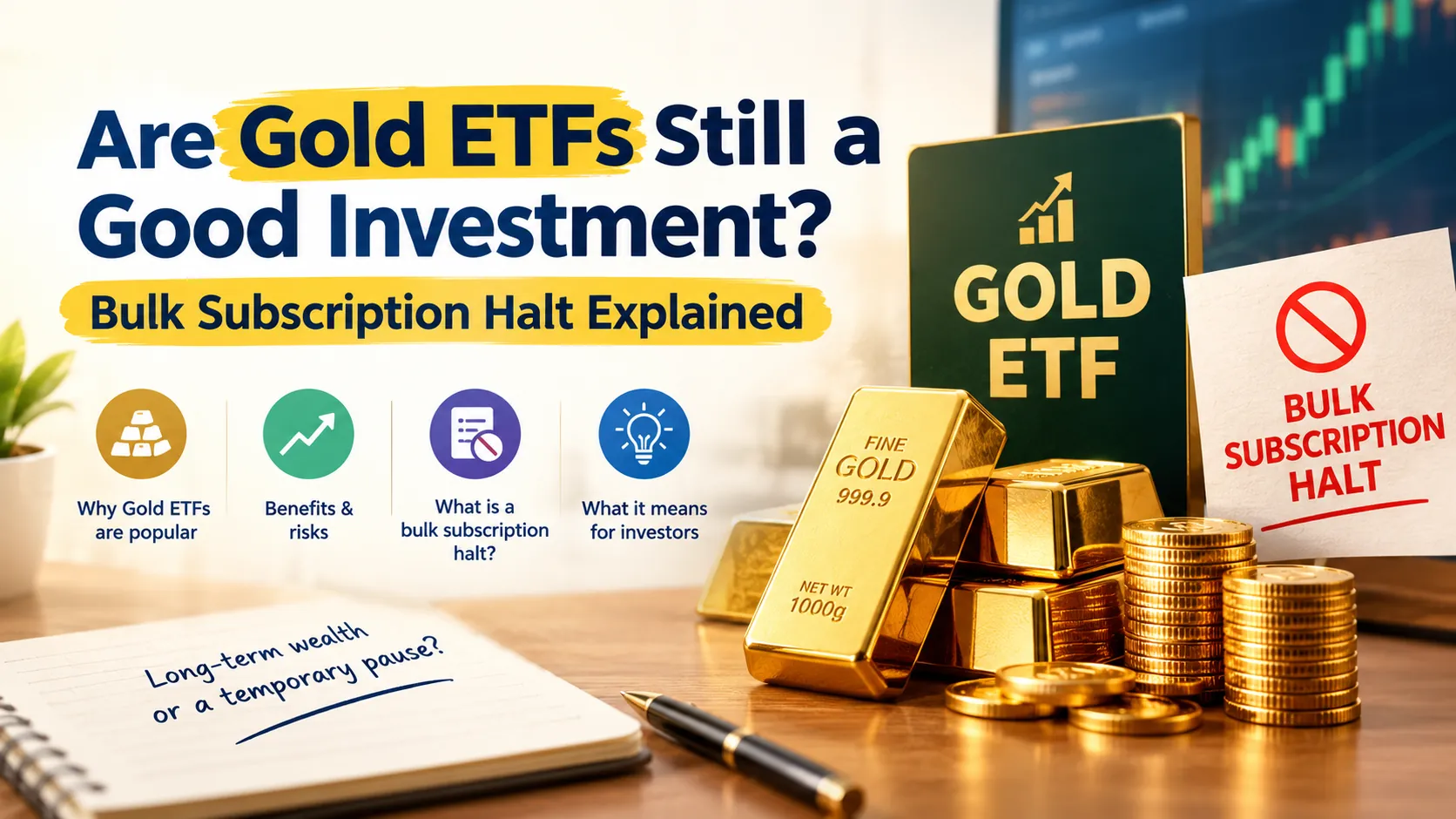
Gold ETFs Bulk Subscription Halt: What Investors Do Now
Funds are pausing bulk subscriptions to gold ETFs. Here is what it means for your gold allocation, what each option costs, and which one to buy.
## Gold ETFs Just Shut the Door on Big Money. Here Is What Retail Investors Should Do.
On 20 October 2026, a mid-sized Indian fund house sent a two-line notice to distributors: bulk subscriptions into its [gold ETF](/blog/gold-etfs-stop-bulk-subscriptions-what-it-means-for-your-festive-sip) would be paused until further notice. By the weekend, three more had done the same. The reason was mundane and telling. The festive season was about to begin, the fund's gold holdings were already sitting at the edge of SEBI's 10 percent single-issuer limit for physical gold, and the fund simply could not create new units fast enough to absorb large inflows.
If you were planning to move a Diwali bonus into a gold ETF this week, you have probably run into a screen that says "subscriptions temporarily suspended." Before you panic-buy [sovereign gold bonds](/blog/gold-etf-freeze-what-retail-investors-should-do-before-festive-season) or chase a gold savings fund, let us look at why this keeps happening and what it actually means for your allocation. For readers who also invest abroad, the same question of platform cost applies to the cheapest investment platform australia offers, but gold ETFs remain a distinctly Indian problem.
### Why funds stop bulk subscriptions
Gold ETFs are physically backed. Every unit you buy means the fund has to buy 1 gram of 99.5 percent pure gold, store it in a vault, and insure it. SEBI caps a single gold ETF at 10 percent of its assets in any one vaulting arrangement, and the vaulting industry in India is concentrated. When a fund nears that cap, it cannot legally accept more money. It has two choices: stop subscriptions, or widen the vault network. The second takes months.
The festive season makes this worse. October to December is when Indian households buy gold, and a lot of that money now flows through ETFs rather than jewellers. A fund that was comfortable in July is tight by October.
### What this means for your allocation
Short version: nothing changes about whether gold belongs in your portfolio. It changes where you buy it.
The bulk subscription halt is a plumbing problem, not a signal about gold prices. But it has three practical consequences for a salaried investor in India:
- **Fresh purchases may fail or get rejected.** If your SIP into a gold ETF is set for the first week of the month, check whether it actually went through.
- **Premium to NAV can widen.** When new units cannot be created, the market price can drift above the fund's underlying gold value. You may pay Rs 78 for something worth Rs 74.
- **Alternatives get crowded.** Money that cannot enter ETFs flows to gold savings funds and SGBs, which pushes their prices up too.
### The selection criteria
Before the list, here is how we ranked the options. Four things matter:
1. **Availability right now.** Can you actually buy it this week, in India, without a broker calling you back?
2. **All-in cost.** Expense ratio plus brokerage plus any premium to NAV, in rupees.
3. **Tax treatment.** Gold ETFs and gold savings funds are taxed at your slab rate if held under 24 months, and at 12.5 percent long-term if held longer. SGBs have a different, more generous structure.
4. **Liquidity.** Can you sell on a Tuesday afternoon at a fair price?
## The ranked options
### 1. Buy the ETF anyway, but use a liquid one
The one to buy. The subscription halt is not universal. Large gold ETFs with diversified vaulting arrangements are still accepting money. Nippon India Gold ETF and HDFC Gold ETF both remain open as of this writing. You pay around 0.5 percent to 0.6 percent in expense ratio, roughly Rs 50 to Rs 60 a year on a Rs 10,000 holding. Brokerage on a delivery trade at a discount broker is Rs 0 to Rs 20.
**Skip it if** you are buying more than Rs 5 lakh in one go. That is exactly the size that triggers the bulk subscription problem. Split it across three months.
### 2. Gold savings fund: the quiet workaround
The value pick. Gold savings funds invest in gold ETFs, so you get the same exposure without needing to buy units on the exchange. The catch is a second layer of fees: expect 0.9 percent to 1.1 percent all-in. On Rs 1 lakh, that is about Rs 1,000 a year, versus Rs 550 for a direct ETF.
**Skip it if** you are a direct-plan investor with a demat account. You are paying an extra 0.5 percent for convenience you do not need.
### 3. Sovereign Gold Bonds: still the best deal, if you can get them
SGBs pay 2.5 percent interest on top of the gold price, and redemption at maturity is exempt from capital gains tax. That is genuinely hard to beat. The problem is supply. The RBI has not announced a fresh tranche in this cycle, and secondary market liquidity is thin. You will pay a premium of 1 to 3 percent over the underlying gold price to buy from an existing holder.
**Skip it if** you need the money within three years. The secondary market spread will eat your gains.
### 4. Digital gold on payment apps: avoid
The one to avoid. A 24 karat buy on a payment app looks cheap at 1 percent, but you pay 3 percent GST on purchase, a spread of 1 to 2 percent on both legs, and storage fees after the first year. On Rs 50,000, you are down roughly Rs 2,500 before gold moves at all. It is fine for buying a coin for a wedding. It is not an investment.
### 5. Physical jewellery: not an investment
A Rs 1 lakh chain carries 3 percent GST, 8 to 12 percent making charges, and a resale discount of 10 percent or more. Buy it because you want to wear it.
## What we recommend
If you are building a 5 to 10 percent gold allocation, buy a large, liquid gold ETF through a direct plan, in monthly tranches of Rs 25,000 or less. That keeps you under the radar of bulk subscription limits and lets you average the premium to NAV. Use a gold savings fund only if you do not have a demat account. Treat SGBs as a bonus if a new tranche opens, not as your primary route.
One more thing. If you are comparing platforms and reading about the cheapest investment platform australia, remember that Australian brokerage rules and Indian ETF rules are different animals. Do not assume a low-cost platform abroad solves an Indian subscription problem.
## FAQ
**Will my existing gold ETF holdings be affected by the subscription halt?**
No. The halt applies to new money coming in. Your existing units stay invested, and you can still sell them on the exchange.
**Is now a bad time to buy gold?**
The subscription halt says nothing about the gold price. It says something about fund capacity. Buy on your allocation schedule, not on headlines.
**Should I switch to a gold savings fund permanently?**
Only if the extra 0.5 percent fee is worth the convenience. Over 20 years, that gap compounds into a meaningful sum.
Frequently asked questions
Will my existing gold ETF holdings be affected by the subscription halt?
No. The halt applies to new money coming in. Your existing units stay invested, and you can still sell them on the exchange.
Is now a bad time to buy gold?
The subscription halt says nothing about the gold price. It says something about fund capacity. Buy on your allocation schedule, not on headlines.
Should I switch to a gold savings fund permanently?
Only if the extra 0.5 percent fee is worth the convenience. Over 20 years, that gap compounds into a meaningful sum.
Why funds stop bulk subscriptions
Gold ETFs are physically backed. Every unit you buy means the fund has to buy 1 gram of 99.5 percent pure gold, store it in a vault, and insure it. SEBI caps a singl
2. **All-in cost.** Expense ratio plus brokerage plus any premium to NAV, in rupees.
 YourMoneyWise